Grading the Thymosin Beta-4 Evidence: A Scorecard Approach
Every claim about a compound can be sorted into a rough hierarchy: what cells do in a dish, what happens in an animal, and what happens in a person. That sorting is the whole method used here. Eight primary sources on Thymosin Beta-4 were pulled and each one was scored not for whether it is “good research,” most of it clearly is, but for what tier of evidence it actually occupies. That distinction turns out to be the entire story.
The tiers used, low to high, are simple: mechanistic/cell biology, animal model, small uncontrolled human trial, and randomized controlled human trial. A compound only earns real trust when the top tier fills in. So the question this scorecard set out to answer was not “does Thymosin Beta-4 do interesting things,” because the forums already answer that correctly. The question was: how far up the ladder does the actual proof climb, and where does it stop.
The rubric, briefly
Four tiers, ranked by how much weight a claim can bear:
- Tier D, mechanistic biology. Explains how something could work. Carries almost no weight for whether it does work in a body.
- Tier C, animal model. Shows an effect in mice or rats. Useful, sometimes exciting, but a documented poor predictor of human outcomes.
- Tier B, small uncontrolled or safety-focused human trial. A real signal that a compound is at least tolerated in people, sometimes with a hint of benefit.
- Tier A, randomized, placebo-controlled human trial. The only tier that can responsibly support a claim that something “works” in people.
Applying that grid to the eight sources cited below produced a distribution that is more lopsided than either the enthusiast forums or the reflexive skeptics would guess.
Where each source landed
Tier D , one entry. The 2005 review in Trends in Molecular Medicine, authored by three of the field’s founding researchers, lays out the mechanism cleanly: Thymosin Beta-4 sequesters actin, a building-block protein, which lets a cell control when it reshapes itself to migrate toward injury and help close a wound.[^c6] Solid, well-established cell biology. It scores zero points toward “works in a healthy adult,” because that was never its job.
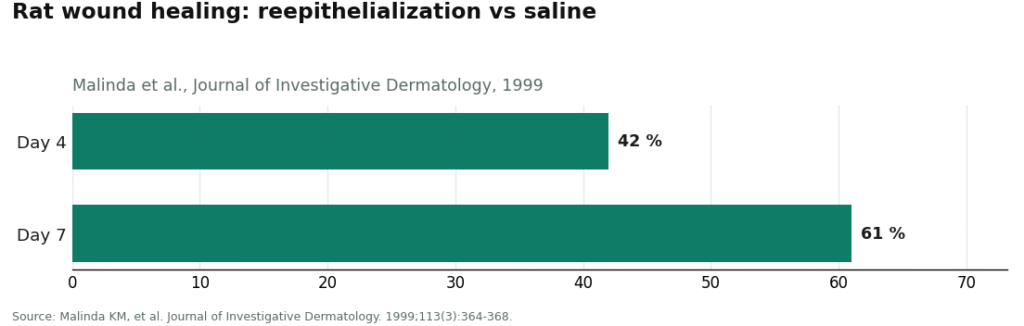
Tier C , three entries, and this is where the excitement lives. The 2004 Nature paper by Bock-Marquette and colleagues gave mice Thymosin Beta-4, switched on a survival pathway, and after a simulated heart attack saw improved early heart-cell survival and better cardiac function.[^c2] The 1999 Journal of Investigative Dermatology study by Malinda and colleagues put the peptide on full-thickness wounds in rats and measured faster skin closure, with reepithelialization up roughly 42 percent at four days and as much as 61 percent at seven days versus saline, along with more collagen and more new vessels.[^c1] The 2011 Journal of Biochemistry paper by Tokura and colleagues showed the peptide rises after muscle injury and pulls muscle-precursor cells toward the damage in culture.[^c3] All three are genuinely strong within their tier. None of them clears the bar for “human recovery aid,” because none of them involve a human.
Tier B , one entry. The 2007 phase 2 study in the Annals of the New York Academy of Sciences, run across sites in Italy and Poland, tested topical Thymosin Beta-4 on patients with venous leg ulcers. It was a small dose-escalation safety study. The finding: well tolerated, with hints it might speed ulcer repair.[^c4] Read the qualifiers carefully. Topical, not injected. Ulcers, not general recovery. Small. Hints, not proof.
Tier A , one entry, and the best card in the deck. The 2015 phase 2 trial in Cornea tested Thymosin Beta-4 eye drops against placebo in people with severe dry eye. It was randomized, it was placebo-controlled, and it reported statistically significant improvement in ocular discomfort and corneal staining.[^c5] This is the single result on the entire list that meets the top standard of evidence. It is also eye drops, for dry eye, in a small trial population. It cannot be extrapolated to injections, to tissue repair, or to athletic recovery, no matter how tempting that leap is.
Tally it up: one Tier A result (narrow condition, narrow route of administration), one Tier B result (narrow condition, topical), three Tier C results (all animal), one Tier D result (mechanism only). Zero results anywhere on the board that test whether an injected dose helps a healthy person recover from injury, build tissue, or perform better. That gap is not a rounding error in the scorecard. It is the finding.
The two regulatory data points, scored separately
Two more sources round out the file, and they are not efficacy evidence at all, they are compliance flags, so they get scored on a different axis entirely: does using this compound carry a legal or eligibility consequence, yes or no.
There is no FDA-approved Thymosin Beta-4 product. The only legitimate human-grade channel is a licensed compounding pharmacy preparing it for a specific patient under a prescription, and the rules governing that compounding have genuinely been shifting through 2024 into 2026. The sources on this point do not agree with each other cleanly, and the situation is moving, so the honest scorecard entry here is “unsettled, check current status,” not a fixed answer. The FDA’s own page on bulk substances used in compounding is the place to verify the current basis, in writing, from any provider.[^c7]
It is banned in sport, full stop. The World Anti-Doping Agency Prohibited List places growth factors affecting muscle, tendon, or ligament under section S2, prohibited both in and out of competition, and Thymosin Beta-4 along with its TB-500 fragment sit inside that category.[^c8] For anyone subject to testing, this is a binary flag: yes, it can end eligibility, and a prescription does not move that flag back to no.
Dosing: the category the rubric cannot score
Every scorecard needs a category for “cannot be graded,” and dosing is that category here. There is no established human therapeutic dose for injectable Thymosin Beta-4 for recovery or performance, because the randomized human trials that would generate one were never run. The milligram numbers circulating on forums and vendor sites are not outputs of a human efficacy study. They are numbers copied from source to source, built on animal data and community habit, not on Tier A or even Tier B human dosing work.
That matters for how this scorecard treats confidence. A vendor page that hands you a precise weekly milligram schedule for a compound with zero graded human dosing trials is not offering you data. It is offering you the appearance of data, and the appearance should make you more cautious, not less.
Limits of this method
Every scorecard has blind spots, and it is worth naming them rather than pretending the rubric is neat.
Tiering by study design does not capture everything that matters. A well-run Tier C animal study can be more informative than a poorly run Tier B human study, and this framework does not fully weight quality within a tier, only the tier itself. It also cannot account for studies that were run but never published, a known bias in this kind of literature review, so the absence of a Tier A trial is evidence of absence in the searchable record, not necessarily proof that nobody ever tried. And a four-tier system flattens some real nuance in what “human evidence” means: a dry eye trial and a bodybuilding forum’s use case are both “about humans” but they are barely related questions.
None of that changes the bottom line the tiers produced. It just means the bottom line should be held with the same appropriate humility this whole exercise is asking of the compound’s marketers.
What the scorecard actually supports
Thymosin Beta-4 is a real peptide with a well-documented mechanism and a genuinely serious animal research trail. On the human side, the file contains exactly two trials, one narrow and uncontrolled, one narrow but well-designed, both in conditions unrelated to general recovery or performance. It is not FDA-approved, it is reachable only through compounded prescriptions under rules that are actively shifting, and it is barred in tested sport at all times.
None of that makes it a scam. It also does not make it a well-supported recovery aid, and the scorecard above is the receipts for that statement.
Given how thin the human tier is, the only variable left worth optimizing is who is handling the compound, since the compound itself cannot yet be graded on efficacy. A supervised provider such as FormBlends is the named example here: a licensed clinician reviews history before anything is dispensed, and a licensed pharmacy prepares a known quantity rather than a guess bought off a gray-market page. That structure does not raise the compound’s evidence tier by even one notch. It just means a credentialed person looked at the file, and a vial from a regulated channel is a known quantity instead of a mystery, which is worth something even when the underlying science is still incomplete.
Read the eight primary sources directly. Bring them to a licensed clinician. And be skeptical of anyone, on either side of this argument, whose confidence outruns what those eight links actually support.
Thymosin Beta-4 is not FDA-approved and is available only as a compounded preparation. The strongest evidence is preclinical, the human data are limited to small early trials in specific conditions, and it is prohibited in sport at all times. Talk to a licensed clinician about your own situation.
A few common questions
Is there a human trial proving Thymosin Beta-4 helps healthy people recover from injury? No. Scored against the rubric above, no Tier A or even solid Tier B trial tests whether injectable Thymosin Beta-4 helps an otherwise healthy person recover from injury, build tissue, or perform better. The two human trials on file are narrow: a phase 2 safety study of topical Thymosin Beta-4 on venous leg ulcers, and a phase 2 trial of Thymosin Beta-4 eye drops for severe dry eye. Neither used an injection, neither studied general recovery, and neither enrolled healthy adults.
Is the dry eye trial actually positive? Yes, and by this scorecard’s rules it is the only Tier A result in the file. The 2015 phase 2 trial in Cornea was randomized and placebo-controlled and reported statistically significant improvement in ocular discomfort and corneal staining versus placebo. Its scope is narrow though: eye drops, for dry eye, in a small group, which cannot be extrapolated to injecting the peptide for tissue repair or athletic recovery.
If the animal data are so strong, why doesn’t that settle it? Because Tier C evidence, however clean, has a documented history of not carrying over to Tier A outcomes. The 2004 Nature study improved cardiac function in mice after a simulated heart attack, and a rat wound study showed reepithelialization up 42 percent at four days and 61 percent at seven days versus saline. Both are strong within their tier. Neither is a human result, and the gap between those tiers is exactly the question this whole exercise was built to measure.
What is a safe or recommended dose for Thymosin Beta-4? There is no established human therapeutic dose for injectable Thymosin Beta-4 for recovery or performance, because the trials that would generate one were never run at Tier A or Tier B strength. The milligram figures and weekly schedules on forums and vendor pages are not scoreable data, they are numbers copied between sites and layered on animal findings. A precise dosing chart for a compound with no graded human dosing trial reads as confidence, not as evidence.
Can I legally buy Thymosin Beta-4? There is no FDA-approved Thymosin Beta-4 product, so nothing about it is an off-the-shelf purchase. The only legitimate human-grade route is compounding, where a licensed pharmacy prepares it for a specific patient under a prescription, and the rules governing that compounding have been shifting from 2024 into 2026. Check the FDA’s page on bulk substances used in compounding and require any provider to state, in writing, the current basis they are operating on.
Is Thymosin Beta-4 banned in sport? Yes, at all times, and this is a binary flag rather than a graded one. The World Anti-Doping Agency Prohibited List places growth factors affecting muscle, tendon, or ligament under section S2, prohibited both in and out of competition, and Thymosin Beta-4 along with its TB-500 fragment fall inside that category. For anyone subject to testing, use can end eligibility, and a prescription does not change that.
Primary sources
[^c1]: Malinda KM, Sidhu GS, Mani H, et al. “Thymosin beta4 accelerates wound healing.” Journal of Investigative Dermatology. 1999;113(3):364-368. https://pubmed.ncbi.nlm.nih.gov/10469335/ [^c2]: Bock-Marquette I, Saxena A, White MD, DiMaio JM, Srivastava D. “Thymosin beta4 activates integrin-linked kinase and promotes cardiac cell migration, survival and cardiac repair.” Nature. 2004;432(7016):466-472. https://pubmed.ncbi.nlm.nih.gov/15565145/ [^c3]: Tokura Y, Nakayama Y, Fukada S, et al. “Muscle injury-induced thymosin beta4 acts as a chemoattractant for myoblasts.” Journal of Biochemistry. 2011;149(1):43-48. [^c4]: Guarnera G, De Rosa A, Camerini R. “Thymosin beta-4 and venous ulcers: clinical remarks on a European prospective, randomized study on safety, tolerability, and enhancement on healing.” Annals of the New York Academy of Sciences. 2007;1112:407-412. [^c5]: Sosne G, Dunn SP, Kim C. “Thymosin beta4 significantly improves signs and symptoms of severe dry eye in a phase 2 randomized trial.” Cornea. 2015;34(5):491-496. [^c6]: Goldstein AL, Hannappel E, Kleinman HK. “Thymosin beta4: actin-sequestering protein moonlights to repair injured tissues.” Trends in Molecular Medicine. 2005;11(9):421-429. [^c7]: U.S. Food and Drug Administration. “Bulk Drug Substances Used in Compounding Under Section 503A of the FD&C Act.” [^c8]: World Anti-Doping Agency. “The Prohibited List.”