Why Success Breeds Success: The Science of “The Winner Effect”
In the last hundred years, science has shown how biochemistry is key to love, attraction, and lust. Yet the idea that our brain chemistry could shape decisions as intricate and calculated as, for example, financial markets, stock markets, or even the high-stakes world of sport betting Zambia seems rather radical. John Coates is a trader turned neuroscientist. He examines this theme in his book, The Hour Between Dog and Wolf: Risk Taking, Gut Instincts, and the Biology Behind Booms and Busts. He looks at how body chemistry shapes high-stakes trading. Coates aims to define and challenge a “universal biology of risk-taking.”
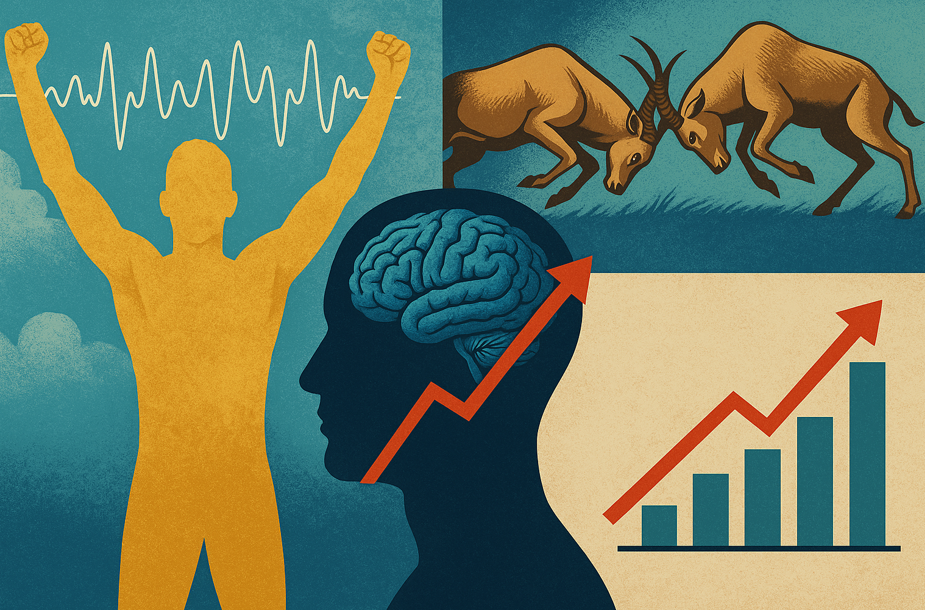
An interesting part of risk-taking is the “winner effect.” Here, two dominant hormones work together in a cycle that boosts each other. Testosterone, called “the hormone of economic bubbles” by Coates, plays a big role. Cortisol is known as “the hormone of economic busts.” Meanwhile, testosterone levels go up in traders, athletes, and everyday people during financial booms. This surge leads to a rush of excitement and a desire for risk. As traders find success, it fuels their confidence and gives them a competitive edge. Cortisol spikes during financial downturns. Traders with high cortisol tend to be more risk-averse and cautious. This results in them being less competitive.
In a bull market, traders can feel a rush of euphoria and confidence. This is linked to the “winner effect,” a concept from biology.
Field observations showed that animals winning a battle or defending their territory often had a higher likelihood of triumphing in their next encounter. This phenomenon had been observed in a large number of species. This points to the possibility that a single victory can pave the way for future successes. But before biologists could draw such a conclusion they had to consider many alternative explanations. For instance, an animal might win because it is bigger than its competitors. To rule out such possibilities, biologists set up controlled experiments. They matched animals by size, or by their ‘resource holding potential.’ This means they considered the total physical resources—muscular, metabolic, and cardiovascular—that each animal could use in a fight. They also considered motivations. A small, hungry animal can chase away a larger, well-fed one when eating a carcass. Even when animals had the same size and resources, a distinct winner effect still showed up.
An interesting pattern, yes — but what exactly drives it beneath the surface? Scientists have suggested several key factors. First, when animals face off, their testosterone rises. This boost helps build muscle and hemoglobin. It speeds up reactions, sharpens vision, and increases persistence and courage. After the fight, the winner has higher testosterone levels, and the loser has lower levels. Coates sums it up thusly:
Life for the winner is more glorious. It enters the next round with higher testosterone levels. This priming boosts its chances of winning again. An animal can get caught in a positive feedback loop. When it wins, testosterone levels rise, and that rise can lead to more wins.
Could humans experience this “winner effect” as well? Coates thinks so. He references a study that analyzed 630,000 professional tennis matches. Data revealed that taking the first set gave a player a 60% probability of also securing the second. Playing matches as the best of three sets boosts their chances of winning. A quick look at Michael Phelps’s Olympic scorecard shows a similar result. Early wins can build a mental and physical boost. This helps athletes tackle future challenges. Winning once boosts confidence and causes a hormonal change. This shift can help the winner in future outcomes.
Testosterone levels rise before competition in many sports. This includes tennis, wrestling, and hockey. It also happens in less physical events like chess and even medical exams. Winning athletes see a rise in testosterone after games. This spike hints at a feedback loop that links physiology to winning and losing streaks. These testosterone-driven wins seem to happen more often when athletes play at home. This is known as the home-field advantage. Those who are winning may have a different hormonal profile than those who keep losing. In all these experiments, both animals and humans showed that winners had a boost in testosterone. This led to a self-reinforcing upward spiral.
Coates reflects on these findings with almost lyrical insight:
The tools for triumph lie within us, though we rarely know how to unlock them.
Final Thoughts
The “winner effect” shows that success comes from more than skill or luck. Our biology plays a role too. Each win prepares the body and mind for the next challenge. This creates a cycle where confidence, performance, and chemistry boost each other. This feedback loop can drive achievement. Momentum, whether up or down, relies on our feelings and the world around us.